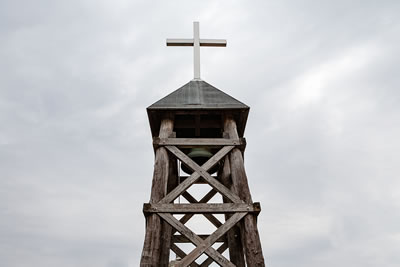
The Columbans started our mission in Korea in 1933 when Korea was very poor and a colony of Japan. Nine newly ordained men arrived in Shanghai, China, to begin there. On arriving, they received a telegram that they were to go to Korea and start a new mission there instead! They didn’t even know where Korea was. Thus, we began our Korean mission. There were very few Catholics, priests, or churches. The Paris Foreign Missionaries were spread too thin, and Columbans came to help. The official language of the country was Japanese, with Korean only used in the homes and churches. Very bad times. In those days, we were aware of the difficulties of working under Japanese eyes, but the focus was on growing the Church. Our men went for twelve years at a time and before they came back, they had been in Japanese jails or under house arrest during World War II. Those were the stories fresh in their minds when they did come home. I think that in those days we just saw the Church as the “Ark of Salvation” to eternal life, and that’s where we focused—keeping the churches going and growing in difficult circumstances.
After the Korean War (1950- 1953), which destroyed the whole country, the Columban Sisters joined the Fathers, coming to help with medical and social needs, founding hospitals and clinics and nursing schools. The Fathers all over the country, Kwangju in the south and Chunchon in the north, were also very involved in passing out cornmeal, flour and powdered milk as much as in baptizing “pagans.” Columban Fr. P.J. McGlinchy started a large operation on the island of Cheju, bringing pigs, cattle, sheep, and horses from Ireland to share with local farmers who had nothing with which to start farming. Columban Fr. Howie Eisel, from Minnesota, started 4H clubs. We were involved with lepers also. Our priests were pastors dealing with lots of social needs. People started flooding into the churches. So, preparing catechists to teach them took up more and more time and funds. And with the decrees of Vatican II, the need to be better at the language also became more evident.
As the 1960s became the 1970s, President Pak Chong-hee became a dictator and developed great programs to modernize the country’s economy, moving millions of young people into cities to work in newly established factories while modernizing farming in the countryside. We Columbans got involved in Young Christian Workers movements, organizing with them in their struggle to be recognized as humans and not mere tools of production. Our faith took us into politics. Many of us inhaled more than a fair share of tear gas.
In the 1980s and 1990s, “Inculturation” was a major theme. After Vatican II, we were called to help bring Korean symbols and culture into the Church. Rome and Latin became less important. When Liberation Theology was evolving in Latin America, we collaborated with Korean theologians on a Minjung (suffering people’s) Theology, seeing and feeling the han or intense feeling of being wronged and oppressed, which is so important in Korean culture.
A number of us started moving into non-clerical situations of living among the people, not in a rectory, but in village farms, at the same time being aware of ecology as necessary for our own lives and the life of the world. This was long before Pope Francis’ encyclical Laudato Si’. Columban Fr. Bob Sweeney from Buffalo moved into a small house in a rural village and worked with local farmers. I moved into a small village with a community of three Columban Sisters and a lay missionary. There was a small chapel in the village, but the pastor in the town didn’t want me to have Mass there, so we usually went by bus with several of our neighbors to the town for Sunday Mass. We lived fairly simply, making compost from grass, weeds, pig manure, and our own manure. Our cabbages were the biggest in the village. It was a mission of “being and working with” the people as Christians. Most of our neighbors were not Christians. We wanted to be examples of international people, priests, religious, lay, men, women living in harmony with each other and with the Earth, both to our neighbors and to the local Church. We also wanted to share with them the name and teaching and work of Jesus, which gives so much meaning to us.
As Korean clergy increased rapidly, we Columbans moved out of parishes, some into hospital chaplaincy roles, others as teachers even in universities, some in Justice and Peace roles, some in using art to express spirituality, some in caring for creation, some in fundraising and mission promotion.
Where there had been almost 150 western-born Columbans living in Korea in 1970, there are now twentyone priests, nine of whom are Koreans, and three lay missionaries. In many ways, the Korean mission is similar to the American mission—emphasis on educating people that there is still a mission going on in the world, raising funds to support it, and doing the best we can within the local church.
There is always a need for foreigners with a “missionary mind” in all local churches. We enrich that vision as we ourselves are enriched by the local people. We take what we are given and follow the Holy Spirit.
Columban Fr. Albert Utzig is the regional director for the U.S.