Before entering the seminary, I was interested in studying architecture. And I still enjoy looking at buildings. I think that the first step in doing a painting is learning to carefully look at the subject matter. During my first few years in the seminary, we had a darkroom, and I got into developing and printing black and white photos. I guess it trained my eye to analyze the composition of images and how they can be improved.
Although I have been messing around with paint off and on for at least 50 years, I still consider myself in the beginning artist category. I was introduced to oil painting by Sister Veronica Julie of the Notre Dame School of the Fine Arts in Milton, Massachusetts, back in my seminary days. Beyond her course, I have had little art instruction. I did take calligraphy lessons in Japan for a short time. Those lessons did help my handwriting in Japanese, but when it came to using a brush and ink, I quickly became discouraged by my lack of progress.
Well, how can you expect progress when you do a painting or maybe two and then put the paints away for months or even years?
After one such hiatus, I returned to the United States for a home leave from my mission. One day, my father remarked to me that he liked the work of a certain woman who sold her work in the local shopping mall. Her work did not impress me except by its repetitiveness. So, I brashly told dad, “Oh, I can do better than that.” He said “prove it.” I produced a small canvas of two people in a canoe with their shapes reflected in the water. My father hung what I called the “challenge painting” over his favorite chair till the day he died. Therefore, I considered it an artistic success.
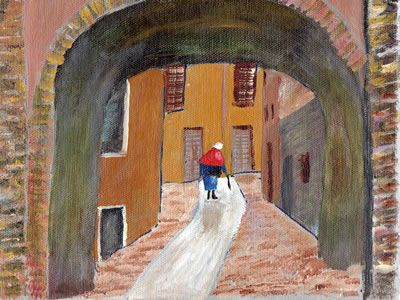
It was a success in another way in that it got me painting again. It was at this time that I decided to switch from oils to acrylic paint. I liked the fact that it dried so quickly and was easy to clean up. Frankly, I think acrylics suit my impatient personality. Because the paint I use dries so quickly, it means that my usual paintings are on the small side. As for subject matter, I usually do landscapes or cityscapes based on vacation photos. When I do landscapes, I usually include some person or building to indicate scale.
 Painting has just been an avocation, but there have been a few times when it has been useful in my ministry. Being able to paint (a little) came in handy one Christmas when the parish’s disassembled stable was mistaken for scrap lumber by someone on an overzealous cleaning streak. The error was discovered a few days before Christmas. I happened to be housebound with a case of pneumonia, so I had the time to paint three simple panels and make a standing triptych, to replace the missing stable. It looked okay and saved the skin of the culprit.
The 1990s found me back in Japan and the parish where I was assigned was home to quite a few artists, some quite successful, including a professor of art at a university in Tokyo. Early in my time there, not realizing this, I let it be known that one of my hobbies was painting. The courteous Japanese took my attempts at messing with brushes much more seriously than my amateurish productions deserved. All the flattery was, I admit, quite encouraging.
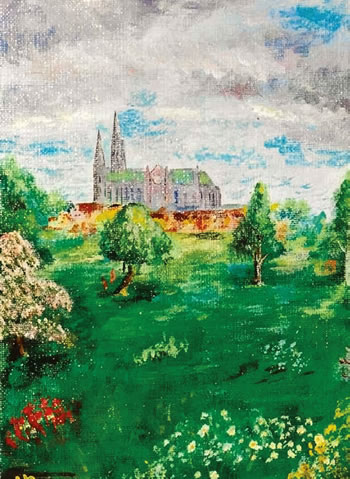
 Probably the most flattering thing that ever happened to me in this connection was when I presented a small painting of Chartres Cathedral to the outgoing parish council president. Imagine my surprise when he and his family traveled to France to stand in that spot!
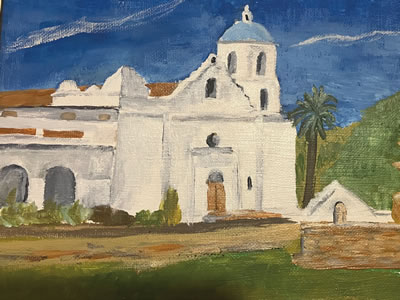
I think my early interest in architecture shows in my choice of subject matter. I have painted a few churches, but few religious paintings. After the September 11 tragedy in New York, I painted a picture of the Blessed Mother weeping over the twin towers, as a way of working through my feelings. Years later, I also painted Paris Notre Dame in flames.
During my time in Japan, I exhibited my work a few times in a local city hall. Also, every year the Tokyo Metropolitan Museum of Art hosts a show called “the Independent” a sort of “come all ye” for any artist of any level. You can imagine the range of creativity in a city as large as Tokyo. It was a thrill to see my own work on display for a few days, in a museum no less.
Columban Fr. Frank Carroll used to describe the Japanese pinball game “pachinko” as not really interesting, but just interesting enough to keep your mind off whatever you are fretting about. Strangely, I feel that way about painting. I can escape into thinking about whether this or that color looks right, and relax.
Columban Fr. John Burger lives and works in the United States.