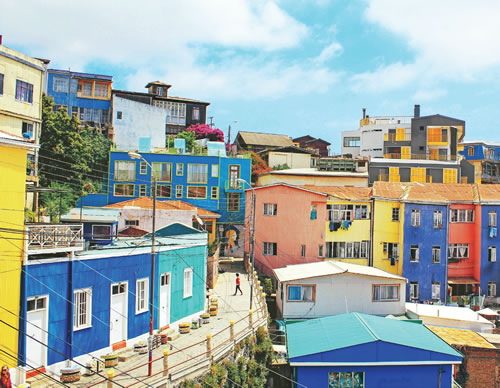
Weekly, I make it a habit to visit randomly the nine chapels of the Columban parish of San Mathias in Bajos de Mena, Santiago, Chile, where I have been sent.
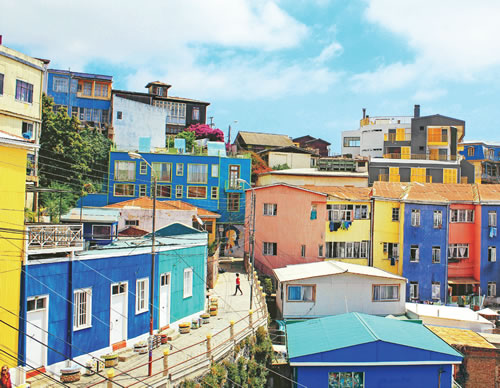
Riding a bicycle, I would try to pedal hard to reach these chapels. It has been a few months since I arrived here, and I am still getting acquainted with the streets. When I know I am very near a chapel, I tend to look up. I gaze and search for the cross among those roofs of the neighborhood of Bajos de Mena. The cross is a significant landmark for me. It is essential too for the church, for the gathered people of God.
Previously, on the 5th Sunday of Easter, a significant day in our liturgical calendar as we celebrate the resurrection of Jesus, the cross remains an integral part of our faith. To gaze lovingly at the cross of Jesus is to bear witness to the defeat of death. It is here that death is devoured by love. What is our experience of death, injustice, abuse, betrayal, and darkness? I believe there is truth in it: We experience resurrection when we try to love. Jesus asked us to live out the new commandment: ”to love others as he loved you.” He showed this reality as our present-day concrete possibility.
As a Columban missionary, I acknowledge the risks of navigating this neighborhood. I recall that on Pentecost Vigil evening, as I was on my way to a chapel, a guy on a bicycle overtook me and abruptly halted in front of me. Thanks to the Holy Spirit, a car moving in the opposite direction honked loudly after noticing the incident. It was a distraction that befuddled the man, and so I escaped safe and sound. I recognize the danger of riding the bicycle I borrowed, not only because of the potential for robbery along the way, but also due to the extreme weather conditions here in Bajos de Mena. These are crosses I bear; however, in the grand scheme of the mission I received, these are the least of my concerns.
What draws me more to go outside, to visit houses and chapels, is not the danger that lurks in the darkness of night, but rather the eagerness to be present, to listen to sacred stories, conversations with the faithful — the crosses they bear, their faith stories of resurrection. How they show love as parents, as grandparents to their complex family, as children to their parents, and as neighbors to one another.
At first, gazing at the roof for the cross guided my arrival to a chapel; now I am gazing at the cross in the lives of Chileans and migrants in Bajos de Mena through personal stories they choose to share. Some stories sprang from socio-economic poverty, the painful conflicts in their relationships, where the family struggles to live despite the illness and sickness, despite the betrayal, and the wounds inflicted by ordained leaders of the church. I’ve seen them still attending Mass. I heard them speak their mind. I savored the bread, the cheese, the Hass avocado, and the warmth of the tea. The smell of coffee was prepared for us to partake. Their faith and resilience in the face of these challenges are truly inspiring.
They choose to love despite the struggle of the cross. This is their cross that devoured death out of love. They loved and kept faith because someone loved them first. They choose to love despite all they have been through. As they share their crosses, I keep those in my heart, placing them in sacred spaces; only God knows the burden of those weights. Their stories of cross and love, despite their challenges, serve as a rich reminder of the tangible grace of God that builds in our human nature. Their life stories fuel me to pedal towards one chapel at a time, one cross at a time, one Spanish conversation at a time.
Now, I am slowly approaching the interior of the church, where the gathered people of God in Bajos de Mena, Santiago, Chile, are present. The next stop, I will focus on three basic ecclesial communities within three chapels; only God knows what the ride will be like. Your prayers and support are valuable and integral to our mission. Let us pray for one another and continue to support each other.
What makes us belong to a place? Is it the time that was spent there or the memories we have of it? Is it the thought “I am here” or the profound sense of comfort and security?
My journey in Chile was marked by unique experiences. I went to the driest desert on Earth, the northern Chilean Atacama Desert. It spreads out in a profound silence. I also ventured to the ”fin del mundo,” the Southern Chilean Patagonia, where the world seemed to dissolve into ice and sky. In this surreal landscape, I held a piece of a glacier in my bare hands, feeling it melt against my skin—the closest I could get to Antarctica. These first experiences were so distinct and unforgettable. Were those first experiences substantial enough to instill in me a sense of belonging?
And then there were the people— each at their best selves when I met them, much like Chilean Patagonia in January and February, at its gentlest. When we share joy, engage in meaningful conversations, and live with a sense of adventure, does that foster a sense of belonging? Do shared experiences and warm hospitality foster a sense of belonging to a place?
What makes us belong to a place? I was sent to a place called Bajos de Mena because there is a parish run by Columbans in Santiago, Chile. It never ceases to cross my mind—the unwavering concern of thoughtful locals, faithful Chilean Roman Catholics, reminding me to “take care of myself ” in the dangerous streets that surround my home. Deep in these reminders, there is care from a neighborhood bound by quiet acts of kindness. Does this, then, make us belong?
“What makes us belong to a place?” What if a migrant asks this question? I stepped into a “campamiento” [shanty town], a refuge for migrants, for informal settlers, where most are not of Chilean origin. Campamiento is a sanctuary where people can start a new life, tending to their families. Where they hold onto the hope that, perhaps, belonging and being able to flourish will follow. Some came from Colombia, Ecuador, Venezuela, and others whose stories I have yet to hear. There was a father and a mother who left with their kids because staying in their country entails paying gangs not to inflict harm on their children. The choice to abandon home is a painful decision they made, where a walk in the park could mean assault, or worse. They are migrants who cross thousands of miles, driven by hope without borders — a hope for safety, for dignity, for a life beyond fear. Perhaps at the very least, a space to survive, if not yet to truly live the fullness of life.
I recall a parish priest cautioning me, “Do not visit public housing projects or shanty towns alone; they are dangerous places.” Some locals shared similar sentiments. Yet, I have already visited two public housing projects, not out of recklessness, but by invitation. Does belonging come from being welcomed?
During a trip organized by a language school, a jarring incident occurred. In a metro station, a woman’s voice pierced the air—sharp, unfiltered: “You are not welcome here, go back to your country.” In the face of such blatant racism, can one truly feel a sense of belonging to a place?
What makes us belong to a place? Embarking on Spanish language studies in Santiago de Chile, I find myself pondering whether the very act of wrestling with language, to meet native speakers where they are, in their own terms and converse with a shared vocabulary we both understand, will allow a profound sense of belonging to a place to begin to take root.
In Bajos de Mena, I entered homes where Chileans welcomed me with open doors. I ate what was offered— tasting pebre [spicy appetizer], the zest of Chilean salad, the warmth of roasted chicken and beef, where I shared a table, whether at lunch or dinner. And in that quiet hospitality, I drank from the same “bombilla” the straw passed around for yerba mate (an herbal tea of South American indigenous origin). Does sharing a meal, surrendering to the unspoken rituals of communion, carve out a sense of belonging?
During a trek far south of Bajos de Mena, I found myself in the company of companions from Belgium, the Netherlands, and North America. We shared the experience of drinking straight from the glacier-fed rivers, and later, that night, tried a sip of the calafate sour, a drink made from calafate berries of the Chilean Patagonia. This act of a shared experience, of lowering our guards to strangers, did it contribute to our sense of belonging to this place?
In Bajos de Mena, I would sleep as close to the Earth as I could. This is Chilean soil, and I had been sent near the Andes Mountains. The floor turned bitterly cold on an autumn night—nine degrees, a freezing sensation for a Filipino accustomed to endless summers. I layered a slab of plywood, a mat, and a sleeping bag—a fragile barrier against the chill. Does surrendering to the ground, feeling the pulse of a place beneath your body, bring belonging?
What makes us belong to a place? Is it the time spent there, or the memories carried forward? Is it presence—the quiet attunement, the peace found despite the specters of danger? St. Columban once said, “We belong to Christ, not to ourselves.” If we belong to Christ, does that, too, root us in a place? Does our belonging to Christ make us belong to a place?
Columban seminarian Lydio Mangao, Jr., provided this reflection.